Agentic Workflow Design: Building Thinking Machines
How to structure AI agents to think, act, collaborate, and improve systematically. Seven principles for production-grade agentic systems.
Beyond Single-Shot Prompts
The first wave of AI applications treated LLMs as fancy autocomplete. You prompt, it responds, you're done. That works for copywriting. It breaks down when you need the AI to reason through complexity, coordinate multiple steps, and recover from failures.
Agentic workflows flip the model: instead of asking an LLM for an answer, you ask it to plan, delegate, verify, and improve.
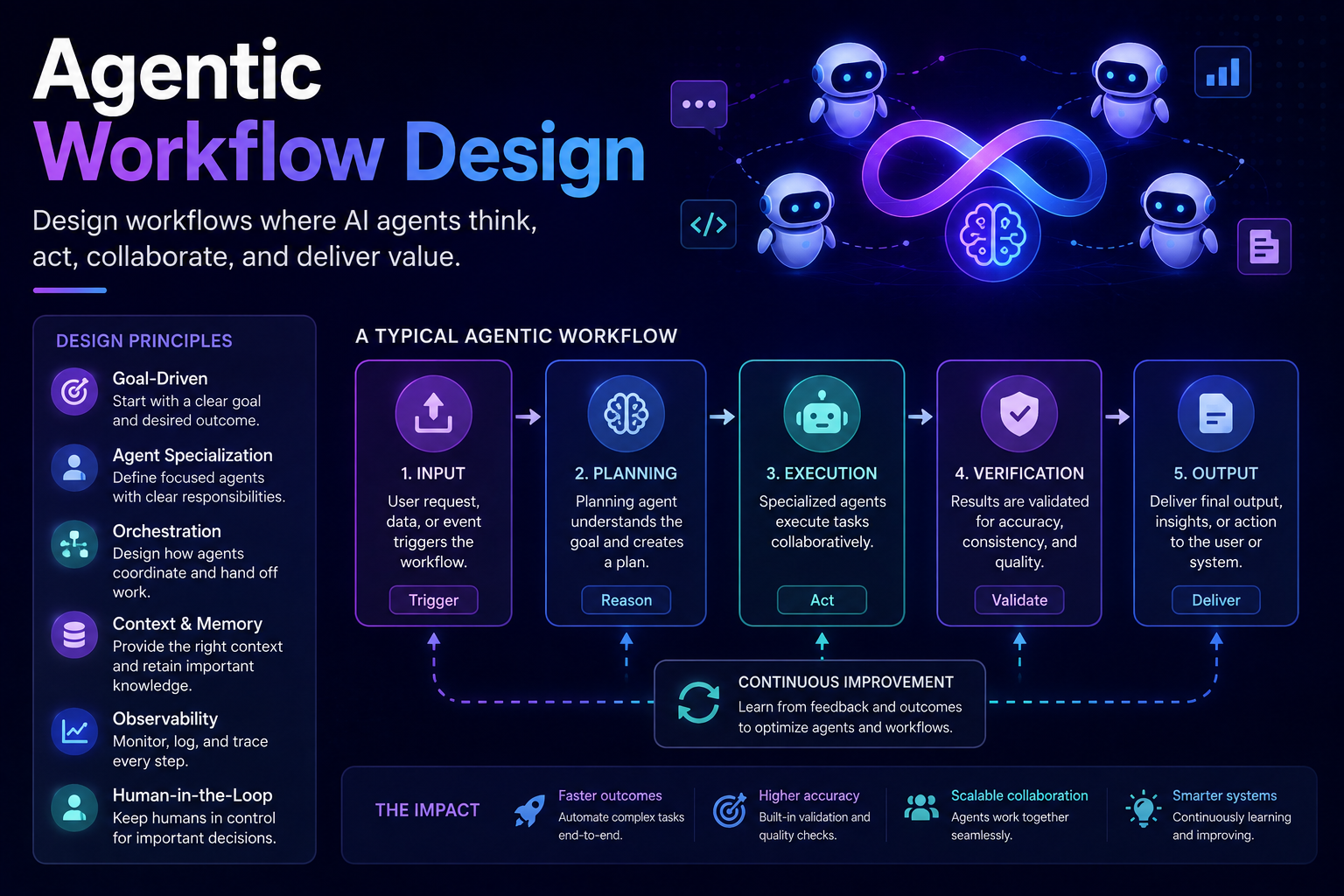
Seven Principles for Agentic Systems
1. Goal-Driven Specification
Be explicit about what success looks like. Not inputs or outputs—outcomes. A vague goal produces vague behavior. An agent without a clear target will hallucinate its own purpose.
2. Specialized Agent Design
Each agent owns one responsibility well. A planning agent. An execution agent. A verification agent. This separation makes it easier to debug, test, and swap implementations.
3. Orchestration, Not Chains
Prompt chains are brittle. You go from step A to B to C linearly. Orchestration lets the system choose which agent to call next based on intermediate results. That's adaptive.
4. Context and Memory
Agents without memory repeat themselves. Without context, they work in isolation. Build systems where agents share a common understanding—through shared memory, decision logs, and previous outcomes.
5. Result Verification
Never trust a single pass. Have agents validate their own outputs before handing off. Did the code compile? Does the output match the spec? Did the plan actually work? Verification is the difference between experimental and production-ready.
6. Human-in-the-Loop
The best agentic systems don't remove humans—they amplify them. Humans approve critical decisions. Humans catch edge cases. Humans course-correct when the system drifts. Automation handles the predictable; humans handle the novel.
7. Continuous Improvement
Learn from every execution. What went wrong? What took longer than expected? Build feedback loops where agent behavior improves with every run.
When This Matters
Agentic workflows excel at:
- Code generation with validation loops (generate, test, fix)
- Complex planning tasks requiring backtracking
- Multi-step problem solving across domain boundaries
- Systems that need to adapt their approach based on intermediate results
They're overkill for simple classification or summarization. Pick the right tool for the complexity you're facing.