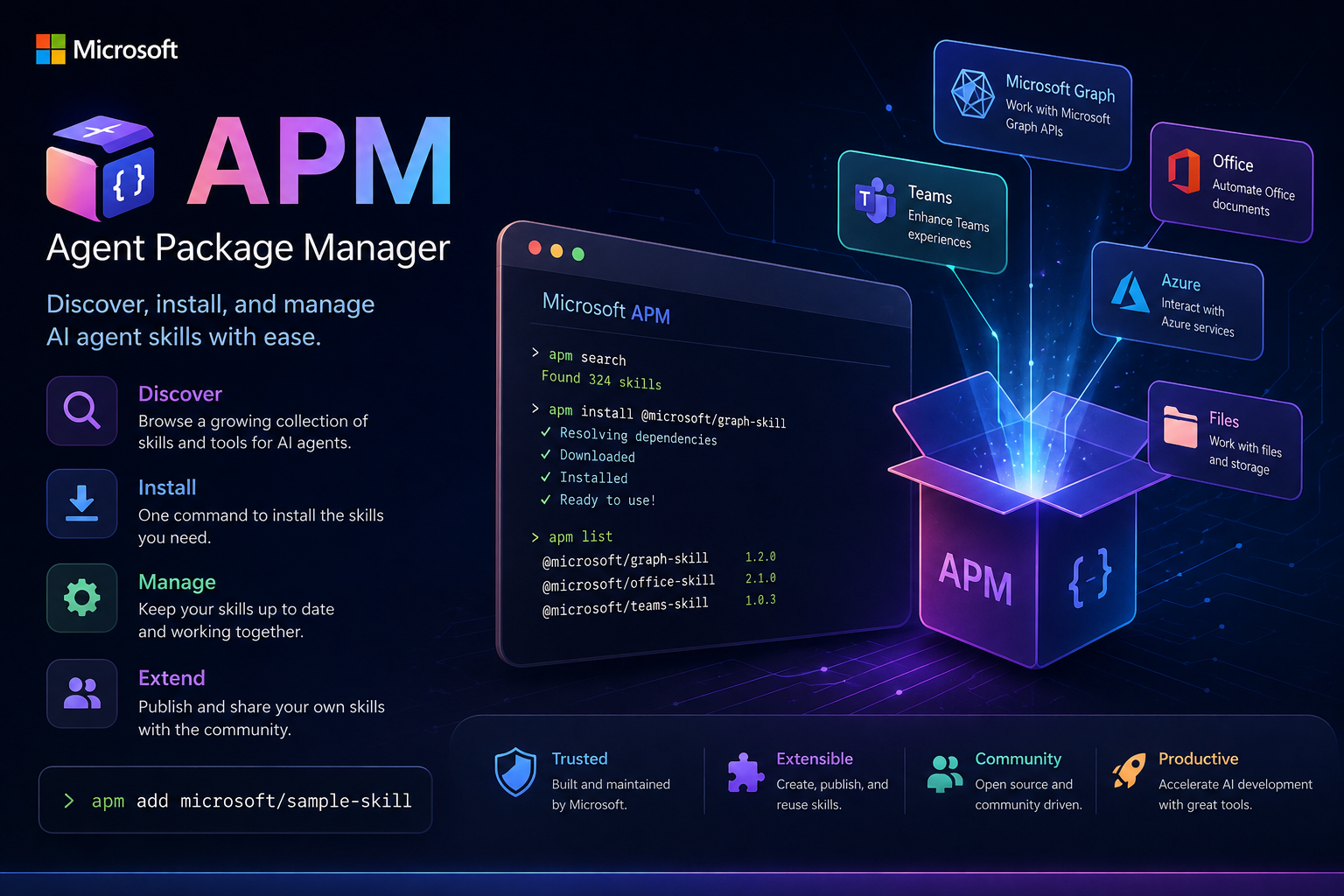
Microsoft APM: Package Management for AI Agents
npm for agents. How a single manifest file is solving agent portability across GitHub Copilot, Claude Code, Cursor, and beyond.
The Portability Problem
Build an agent for GitHub Copilot. Now port it to Claude Code. Now to Cursor. Each platform expects different configuration formats, skill declarations, and plugin structures. You end up maintaining three versions of the same agent.
That's the problem Microsoft APM solves.
What Is APM?
Agent Package Manager is npm for AI agents. One apm.yml file declares:
- What your agent can do (skills, tools, capabilities)
- What it needs to know (prompts, system instructions, context)
- What it integrates with (MCP servers, external APIs, plugins)
- How it's configured (parameters, defaults, dependencies)
Then any harness—GitHub Copilot, Claude Code, Cursor, Anthropic's CLI—reads that one manifest and installs the agent consistently.
Why This Matters
For Developers
Write once. Ship to multiple platforms. No more bikeshedding configuration formats. No more porting headaches.
For Organizations
Standardize how agents are packaged and shared internally. Create a registry. Build abstractions on top of abstractions without losing portability.
For the Ecosystem
Agent development stops being platform-specific. Tools like GitHub Copilot, Claude Code, and Cursor are no longer silos—they're consumers of a common specification.
The Deeper Insight
This isn't just about file formats. It's about treating agents as distributable software components, not platform-specific features. When npm arrived, it didn't just solve node package management—it created a commons where independent developers could build on each other's work.
APM is attempting the same for AI agents. The winners will be the ecosystems that embrace the standard earliest.